CERATIZIT invests in tomorrow’s engineers
Published:

When a University of Sheffield student team set out to machine titanium locomotive wheels on a modest budget, CERATIZIT UK & Ireland’s best-in-class titanium grade, and the application know-how behind it, turned an unviable idea into a competition-ready innovation.
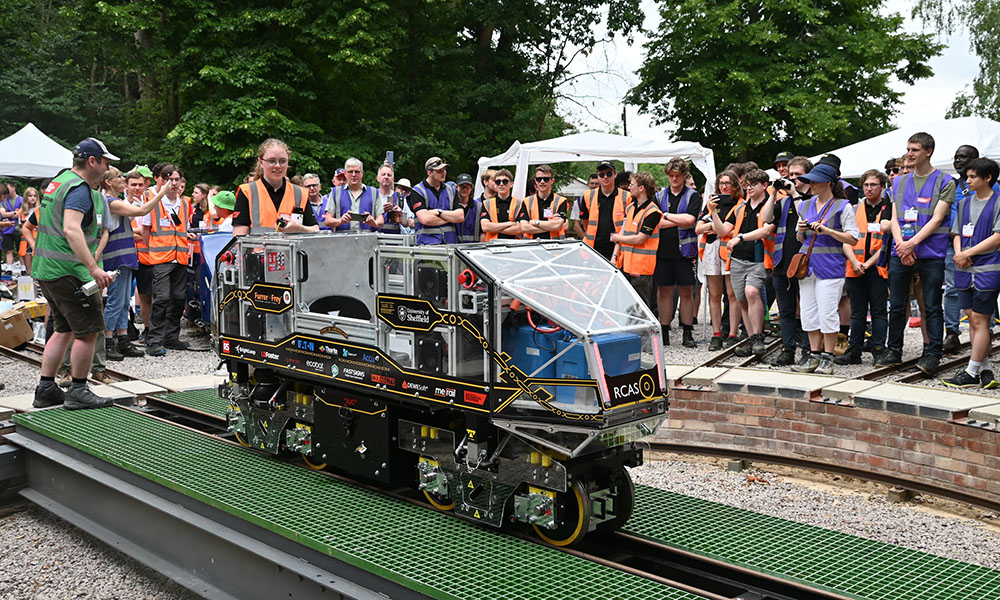
The RCAS train from a previous competition
For a cutting tool manufacturer, few opportunities carry as much long-term value as working directly with the engineers of tomorrow. CERATIZIT’s growing relationship with the Railway Challenge at Sheffield (RCAS) team at the University of Sheffield is exactly that — a partnership that combines an immediate, demanding technical challenge with a meaningful investment in the next generation of manufacturing professionals.
RCAS is a student-led engineering team that designs, builds and competes with fifth-scale locomotives in the annual IMechE Railway Challenge. The event pits more than 16 teams of university students, apprentices and graduates against a comprehensive set of track- and paper-based challenges, each designed to replicate the real pressures facing the rail industry, from auto-stop performance and ride comfort to maintainability, energy storage and a 150-point innovation award.
In its 13-year history, RCAS has grown to more than 35 active students. In 2023-24, the team claimed the Grand Champions title with six individual challenge wins. The 2025-26 locomotive is a ride-on machine weighing approximately 1,000kg and running on 10¼-inch gauge track. It is the team’s most ambitious build to date, and CERATIZIT are playing a central role in making it possible.
A relationship built on a shared postcode
CERATIZIT’s involvement with RCAS began in the 2024-25 season, when Manufacturing Coordinator Oscar Bennett found that the precision required to machine the team’s aluminium axle boxes was beyond the capability of their existing tooling. He contacted CERATIZIT’s Tony Pennington — noting, pragmatically, that both the team and CERATIZIT are based in Sheffield. CERATIZIT supplied end mills from its aluminium-optimised range, and the quality of the results quickly established the basis for an ongoing collaboration.
“I emailed and said, we’re doing something in Sheffield, and you’re in Sheffield too — would you like to help our student team out?” Oscar recalls. “Tony loved the idea and said yes. The aluminium-line cutters were superb. They worked really well.” When the far more demanding challenge of machining titanium arrived for the 2025-26 season, the team knew exactly where to turn.
Where tooling makes or breaks the project
The centrepiece of RCAS’s 2025-26 innovation entry is a proposal to machine locomotive wheels from billets produced using Field Assisted Sintering Technology (FAST) — a process that consolidates titanium machining swarf into a solid, usable material under electrical current and pressure, closing the loop on material that would otherwise require energy-intensive re-melting. The innovation targets a weight saving of around 30kg per bogie compared with conventional steel wheel sets, delivering significant benefits for unsprung mass, dynamic performance and the railway industry’s long-term sustainability goals.
Machining the wheels demanded a full sequence of titanium machining, from facing, OD turning, deep-hole drilling, precision boring for the taper-lock interface with the axle, pocket milling and final flange turning. Without the right tooling, the university’s in-house machinist estimated that consumable costs alone could reach £5,000 — nearly a fifth of the team’s entire £29,000 annual budget.
“For something that scores 8 percent of the overall challenge, spending a quarter of our budget on tooling was never going to be cost-effective,” says Oscar. “We knew we needed to find a partner who could make this possible — and given the experience we’d already had, we knew exactly who to call.”
Keeping the project on track
The tooling cost and consumption implications of machining titanium with existing tooling stock carried a risk of derailing the team's ambitions of success. Tony Pennington introduced Oscar to Stephen Pennington, a CERATIZIT application specialist at the company’s Technology Centre in Sheffield, who took ownership of the tooling package from the first conversation.
The team had already planned its operations and begun programming on two XYZ BT40 taper 3-axis VMCs; what they needed was a partner who could supply and match the right titanium-grade tooling to each operation. That is precisely where Stephen’s product knowledge proved decisive.
At the heart of the package sat CERATIZIT’s CTC5240 — the industry-leading grade specified for the indexable milling inserts and the single most important technical decision in the project. This grade has built its reputation via its staggering performance on titanium machining in the aerospace industry.
“CTC5240 is our best-in-class milling grade for titanium,” says Stephen Pennington. “It’s considered the best out of any cutting tool company for machining titanium.” That claim matters more now than ever. “There’s a big uptake in aerospace and defence right now, so we want to make it clear that we’ve got the best product for machining titanium.”
The tooling package
With the grade settled, Stephen specified a compact suite of tools matched to the operations and the machines available. Face milling and pocketing were handled by two CERATIZIT Coreline A251 shell mills. One was a 52mm diameter tool body carrying five MaxiMill RPHX inserts, and the other was a 42mm diameter body running the smaller button-style RPHX inserts, both loaded with the CTC5240 grade inserts. The critical entry bore for the taper-lock interface, along with the deep-hole drilling, was opened by a 4XD 40mm indexable KUB Pentron drill with through-coolant and SOGX inserts. This paved the way for a boring bar to follow and bring the bore to its finished diameter.
The OD turning and facing were carried out using a Coreline lever-clamp turning holder with CNMG inserts, while two 16mm, four-flute solid carbide MonsterMill end mills with a 3mm corner radius completed the package for profiling and finishing work.
“Stephen just knew which products would be best applicable to each operation,” says Oscar. “It was a really easy process because of his expertise.” Stephen did not stop at the specification. During the team’s manufacturing week — when the locomotive is assembled from the ground up, he visited the RCAS lab and delivered the tooling directly. “He brought the tools over and unboxed them with us, had a look around the machine shop, and we gave him a tour of the lab,” says Oscar.
Performance on the machine
The Pentron drill provided an early test of how CERATIZIT’s tooling would perform in a university environment. As the wheelsets for the project were not on a strict deadline, the capable XYZ machines ran the 40mm drills with the programmed feed rate halved as a precaution. “It got through the wheels in seconds with no issues. The inserts looked like they hadn’t even been used. It was incredible,” says Oscar.
Lasting value for RCAS
The benefits to the team extend well beyond a single competition. The CERATIZIT package solved a problem that had threatened to make the titanium innovation unviable, bringing a £5,000 consumable estimate down to a fraction of that figure and freeing budget for the rest of the build. Crucially, the tools are not single-use.
Stephen confirmed that the shell mills, drill and turning holder can be retained by the university and re-applied to other materials simply by swapping inserts around at a nominal cost. This practical, low-cost capability will serve the machine shop well beyond the 2026 season.
Just as importantly, the partnership has given a cohort of student engineers direct, hands-on experience of industry-grade titanium tooling and the application thinking behind it. The students machining titanium wheel billets in a Sheffield workshop today will be specifying cutting tools and making procurement decisions across aerospace, rail, automotive and energy in the years ahead — and the product knowledge and brand affinity built through a partnership like this carries a weight that no catalogue or trade show stand can replicate.
RCAS heads into the IMechE Railway Challenge from 24th to 28th June 2026, and the event is open to spectators on the 27th and 28th of June. With its titanium wheel innovation as the headline entry, a running locomotive, and a suite of CERATIZIT tooling that helped make the most technically demanding element of the build achievable on a student budget – there is an abundance of engineering to see at the event.
www.ceratizit.com